
_curves_of_detrital_zircon_u-pb_ages_from_sample_23ms-wi.tiff)
_curves_for_wilcox_group_samples_along_the_western_and_east.tiff)
INTRODUCTION
Detrital zircon U-Pb age spectra from Paleocene and Eocene strata along both the western and eastern Gulf Coastal Plain contain near syndepositional Cenozoic grains (e.g., M. D. Blum et al., 2017; M. Blum & Pecha, 2014; Craddock et al., 2021). This provides an opportunity to understand sediment provenance, bracket depositional ages, and correlate regional stratigraphy by determining maximum depositional ages (MDAs). Approaches to calculating MDAs are based on the principle of inclusions and commonly utilize either the youngest single grain or a weighted mean of the youngest grain population (Dickinson & Gehrels, 2009). The choice of method varies depending on how researchers treat statistical outliers and define the youngest population (Coutts, 2019; Copeland, 2020). Recently, the use of a maximum likelihood age (MLA) has been proposed as a statistically robust alternative that reduces bias and improves accuracy (Vermeesch, 2020; Vermeesch, 2021; Schwartz et al., 2023). However, the utility of MDA estimates for stratigraphic and provenance interpretations remains limited without accounting for the geologic and depositional setting. To address these limitations, we ask: How do detrital zircon U-Pb age spectra from the basal Wilcox Group in northeastern Mississippi inform our understanding of MDA calculation methods, sediment provenance, and regional stratigraphic correlations across the Gulf Coastal Plain?
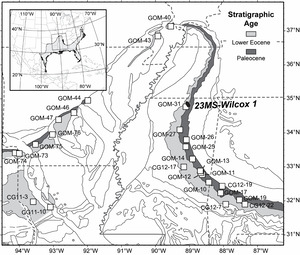
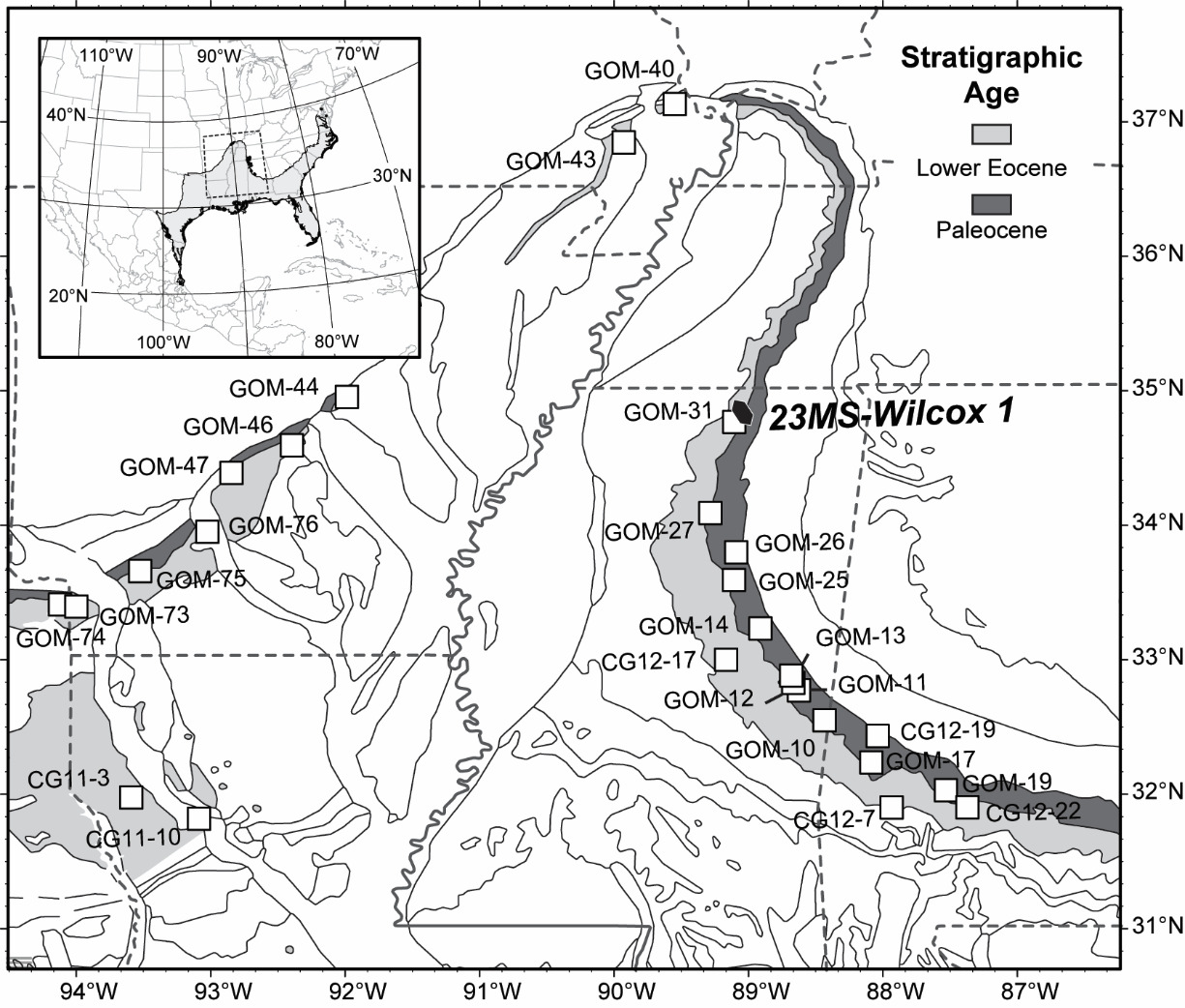
We present detrital zircon U-Pb geochronology from a sample collected at the base of the Wilcox Group in northeastern Mississippi (correlative to the Gravel Creek Sand Member, Nanafalia Formation). This data (N=1, n=355) is integrated with previously published Wilcox Group datasets (N=33, n=3428) from both the western and eastern Gulf Coastal Plain (Figure 1; M. D. Blum et al., 2017; Craddock et al., 2021). Our analysis tests the hypothesis that increasing the number of U-Pb analyses (higher n-values) improves the likelihood of detecting near syndepositional zircon populations, which are often sparse and associated with active volcanism (Sharman and Malkowski, 2020); thereby, enhancing MDA accuracy (e.g., Vermeesch, 2004; Pullen et al., 2014). In addition, this dataset provides new insight into sediment source rock terranes during deposition of the basal Wilcox Group along the eastern Gulf Coastal Plain. These findings inform both methodological considerations in calculating MDAs and regional reconstructions of the North American drainage evolution during the latest Paleocene to earliest Eocene.
GEOLOGIC SETTING
Crustal extension and seafloor spreading associated with the breakup of Pangea and the separation of the North and South American plates shaped the crustal architecture of the Gulf of Mexico (Harry & Londono, 2004; Salvador, 1987; Sawyer et al., 1991; Huerta and Harry, 2012; Filina et al., 2022). Initial Late Triassic through Early Jurassic rifting produced basement grabens and half grabens filled with terrestrial deposits, followed by a main rifting phase during the Late Jurassic through Early Cretaceous (Bird et al., 2005; Jacques & Clegg, 2002; Marton & Buffler, 1999; Pindell & Kennan, 2001; Dickinson et al., 2010). Overlying these syn-rift deposits, the northern Gulf of Mexico preserves a nearly continuous record of mid-Cretaceous through Pleistocene deposition along a divergent passive margin and describes the relationships between North American tectonics, global climate, and eustatic sea level (Galloway, 2008; Winker, 1982, 1984; Winker & Buffler, 1988).
The Mississippi embayment represents a northern extension of the Gulf of Mexico basin, encompassing an area from southern Arkansas and adjacent central Mississippi to southern Illinois and southeastern Missouri (Cushing et al., 1964; Hosman, 1996). Cox and Van Arsdale (2002) proposed that the embayment formed through a distinct mid-Cretaceous basin-forming event, potentially triggered by passage over the Bermuda hotspot, followed by igneous intrusions, regional uplift, and subsequent subsidence. Deposition initiated in the eastern embayment and adjacent Central Basin during the basal mid-Cretaceous transgression with the Tuscaloosa gravels; the depocenter then migrated westward through the Late Cretaceous to the Eocene (Stearns & Marcher, 1962). Basin-scale sedimentation effectively ended by the latest Eocene following deposition of the Jackson Formation, after which sedimentation and subsidence shifted southward to the Gulf of Mexico basin (Galloway, 2008).
Various clastic wedges along the western and eastern Gulf Coastal Plain record sediment routing networks throughout the Mesozoic and Cenozoic (Galloway, 2008; Snedden et al., 2022). Drainage networks supplying sediment to the eastern Gulf Coastal Plain evolved significantly throughout the Mesozoic and Cenozoic (M. Blum & Pecha, 2014), and modern provenance studies suggest that major river systems, particularly the Apalachicola River, continue to dominate sediment input with minimal influence from storms or coastal reworking (Giles et al., 2023). During the Late Cretaceous, regional drainages sourced material from the Illinois Basin, Appalachian foreland, and the southern Appalachian thrust belt (M. D. Blum et al., 2017; M. Blum & Pecha, 2014; Gifford et al., 2020; Jackson et al., 2021; Potter-McIntyre et al., 2018). Between the latest Cretaceous and Paleocene, drainage reorganization resulted in continental-scale river systems that began routing material from the western US Cordillera to the western Gulf Coastal Plain and through the northern Mississippi embayment (McKay et al., 2012; M. D. Blum et al., 2017; Craddock et al., 2020; Pecha et al., 2023). At the same time, the focus of subsidence in the embayment migrated from east to west (Stearns & Marcher, 1962), with sediment routing across the eastern Mississippi embayment at times, potentially reworking Cretaceous deposits, and at other times being directed from the north (Potter & Dilcher, 1980). By the Late Paleocene-Early Eocene, sediment derived in part from western US Cordillera is evident in the eastern Gulf Coastal Plain (M. D. Blum et al., 2017; M. Blum & Pecha, 2014; Craddock et al., 2020).
Wilcox Group Strata
Frazier (1974) recognized transgressive-bound depositional episodes throughout the Cenozoic strata of the northern Gulf of Mexico, which define regional-scale stacking of progradational marine and coastal facies with aggradational coastal plain and fluvial facies. Subsequent studies have developed a genetic stratigraphic framework for Cenozoic strata that clarifies the relationships between sediment supply, accommodation, and eustatic sea level (Galloway, 1989a, 1989b, 2002; Gradstein et al., 1995; Handford & Loucks, 1993; Mancini & Puckett, 1995; Morton & Ayers, 1992). The Lower Wilcox depositional episode records the first major Cenozoic influx of sediment onto the northern Gulf Coastal Plain (Galloway, 1989; 2008).
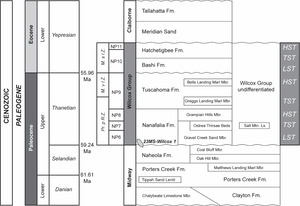
In Mississippi and Alabama, the Wilcox Group is divided into the Nanafalia Formation, Tuscahoma Sand, Hatchetigbee Formation, and Tallahatta Formation, from oldest to youngest. The Paleocene Nanafalia Formation, which lies in disconformable contact with the underlying Paleocene Naheola Formation (upper Midway Group) (Thompson, 2000), is further divided in northern Mississippi into the Gravel Creek Sand and Grampian Hills members (Figure 2). The Ostrea thirsae beds, comprising a prominent marine marker, are absent in the northern part of the Mississippi, as in adjacent western Tennessee, where the Wilcox comprises only up-dip fluvial facies (Russell & Parks, 1975); highlighting a tenuous correlation to marine facies but may be correlated with interbedded coals (Thompson, 2000). The Gravel Creek Sand Member is a discontinuous unit ranging from 0-15 m thick, typically composed of quartzose, micaceous, cross-bedded, medium- to coarse-grained sand that typically fines upward and includes clay-clast conglomerates and carbonaceous to lignitic mudstone in the upper part (Mancini & Tew, 1995; McMillin, 2007). Although this member is regionally correlated with nanoplanktonic zone NP6 based on biostratigraphic zonation of the overlying Ostrea thirsae beds on well-preserved Alabama sections, diagnostic marine fossils, such as Ostrea thirsae, and calcareous nannofossils have not been reported from the Gravel Creek Sand in northern Mississippi, making the correlation inferred rather than directly observed (Gibson et al., 1982; Mancini & Tew, 1995). Potassium-argon age determinations from glauconitic sand beds in the overlying Ostrea thirsae beds and the underlying Naheola Formation constrain the Gravel Creek Sand Member to between 56.3 ± 1.5 Ma and 58.2 ± 1.5 Ma, respectively (Mancini & Tew, 1995).
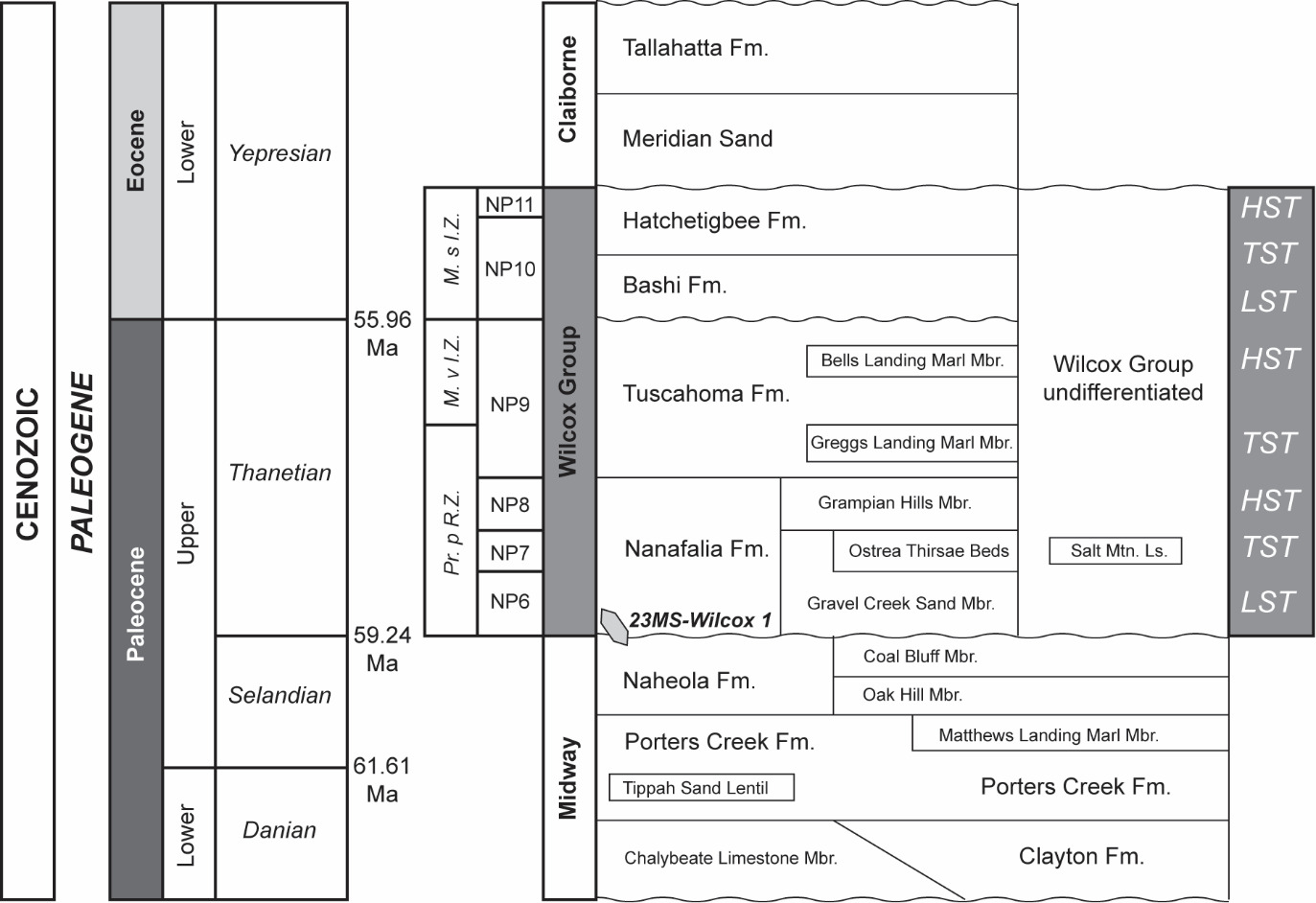
Mancini and Tew (1995) place the uppermost Midway Group and Wilcox Group strata within a sequence stratigraphic framework. In their model, the uppermost Midway Group (Naheola Formation) represents a highstand systems tract (HST), disconformably overlain at a sequence boundary (SB) by Wilcox Group strata of the Gravel Creek Sand Member and Ostrea thirsae beds. In this context the Gravel Creek Sand strata represent incised valley fill of a lowstand systems tract (LST) and the Ostrea thirsae beds represent strata deposited in a transgressive systems tract (TST). The Gravel Creek Sand Member correlates with the TA2.1 (Haq et al., 1988) and TP2.1 (Baum & Vail, 1988) sequence stratigraphic intervals, dated to approximately 58.5-57 Ma (Mancini & Tew, 1995). However, given the absence of marine fossils in northern Mississippi and the tenuous correlation of coal strata, the age and sequence stratigraphic significance of the Gravel Creek Sand Member is poorly understood. Similar poorly bracketed stratigraphic correlations are common throughout the northern Mississippi Embayment, where marine fossils are largely absent (Cushing et al., 1964; Waldron et al., 2011) and Paleocene and Eocene pollen assemblages in carbonaceous strata remain poorly systematized in the Mississippi embayment (Potter & Dilcher, 1980; Frederickson et al., 1982), but are better characterized in the Texas Gulf Coast (Crabaugh & Elsik, 2000; Elsik & Crabaugh, 2001; Zarra et al., 2019).
METHODS
Sample 23MS-Wilcox 1 was collected from the basal Wilcox Group in northeastern Mississippi (34.782327 N; -88.939100 W). The sample is a yellow to rust colored, medium-grained, subangular to subrounded, moderately sorted sand that weathers tan and reddish-brown in outcrop. The stratigraphic interval is correlative to the Gravel Creek Sand Member of the Nanafalia Formation in Alabama.
Heavy mineral separation was conducted by Zirchron, LLC, following standard procedures. Whole zircon grains were picked under dry air with tweezers and mounted on clear acrylic disks with 3M double-coated tape, using a Leica M125 stereomicroscope. Zircon U-Pb data were collected using an ESI NWR 193 nm Excimer laser ablation system coupled with a Thermo Scientific iCapQ quadrupole mass spectrometer at the University of Arkansas in the Trace Element and Radiogenic Isotope Lab (TRAIL), utilizing a 20 μm spot diameter. Grains were selected using the ESI software by systematically scanning in a grid pattern to minimize selection bias, though grains with visible fractures or inclusions were excluded.
Data were reduced using Iolite version 4 (Paton et al., 2011). The Plesovice zircon (Sláma et al., 2008) was used as the primary standard, with 91500 as a secondary standard (Wiedenbeck et al., 1995). Baseline corrections were established with a 2-standard deviation (SD) outlier, and all standards and samples were analyzed with a 3-SD outlier. The baseline was cropped to show 1–30 seconds of the signal, whereas the standards and the samples were cropped to show 12–21 seconds of the signal. Systematic error was propagated through all analyses. A transition from 238U/206Pb to 206Pb/207Pb ages at 1250 Ma was applied to ensure consistent isotope system comparison of Appalachian and Grenville populations. Rim and core domains were visually identified using Iolite, allowing multiple age determinations per zircon via depth-profiled laser ablation.
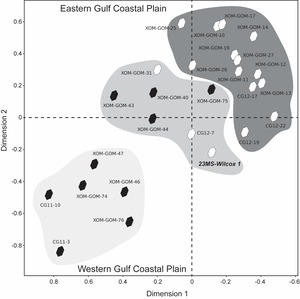
Post-processing included filtering by discordance; only analyses with a discordance between –5% and +20% were retained. Detrital zircon U-Pb age distributions were visualized using Kernel Density Estimate (KDE) curves, 2σ error envelops in Concordia space, a weighted mean average plot, and a maximum likelihood age plot (Figure 3). For comparison, previously published Wilcox Group detrital zircon datasets (Figure 1; M. D. Blum et al., 2017; Craddock et al., 2021), were compiled. Cross-sample similarity was evaluated using KDE curves in IsoplotR (Vermeesch, 2018) and cross-correlation coefficient values plotted in multidimensional scaling space via detritalPy (Sharman et al., 2018).
_curves_of_detrital_zircon_u-pb_ages_from_sample_23ms-wi.tiff)
Maximum Depositional Ages
Maximum depositional age (MDA) calculations of detrital zircon datasets use an array of approaches, which often produce variable results. The most commonly employed approaches are youngest single grain (YSG), youngest grain cluster at 1σ (YGC1σ), youngest grain cluster at 2σ (YGC2σ), youngest probability peak (YPP; also referred to in the literature as youngest graphical peak) (Dickinson & Gehrels, 2009), youngest statistical population (YSP) (Coutts et al., 2019), and the maximum likelihood age (MLA) (Vermeesh, 2021). MDAs for YSG, YGC1σ, YGC2σ, YPP, and YSP were calculated using detritalPy (Sharman et al., 2018), and MLA was calculated using IsoplotR with a logarithmic transformation and minimum finite mixtures (Vermeesch, 2021).
The YSG method identifies the youngest single grain analyzed in a sample or interval. Originally determined by utilizing 1σ uncertainty, unless the 1σ is > 10 Ma and overlaps at 1σ with next youngest age, in which case the next youngest grain would be selected for the YSG (Dickinson & Gehrels, 2009). This method was further refined by Sharman et al. (2018) to define the youngest grain by sorting ages + 2σ and selecting the first entry of the list, which can select an older, more precise grain. The youngest grain cluster at 1σ (YGC1σ) is calculated by the weighted mean of the youngest two or more grains whose ages overlap within 1σ uncertainty. The cluster from the sub-sampled analyses is limited by the upper uncertainty of the youngest grain (Dickinson & Gehrels, 2009; Sharman et al., 2018). Similarly, the YGC2σ relies on the weighted mean of the youngest three or more analyses overlapping at 2σ uncertainty. The YPP is defined as the youngest peak on a probability density plot (PDP), discretized at 0.1Ma, containing two or more analyses that overlap within 2σ uncertainty (Dickinson & Gehrels, 2009). There is no uncertainty error associated with this method and it is commonly used to estimate the upper limit (i.e., most conservative) for a MDA calculation. The YSP is produced from the weighted mean of the youngest grain cluster with a MSWD closest to 1. This method is iteratively, beginning with the two youngest grains, followed by the addition of grains sequentially until the MSWD exceeds 1 (Coutts et al., 2019; Herriott et al., 2019). The MLA is based on the maximum likelihood estimation and assumes the sample is composed of two populations, a discrete minimum age peak and the remaining ages as a log-normal distribution truncated at the minimum age peak (Galbraith, 2005). MLAs are derived from the minimum age peak (Vermeesch, 2021).
RESULTS AND INTERPRETATIONS
Sample 23MS-Wilcox 1 exhibits an age spectrum defined by western North America cordillera (< 250 Ma), Appalachian (490-270 Ma), Peri Gondwana (850-550 Ma), Grenville (1250-900 Ma), Granite-Rhyolite (1550-1300 Ma), Yavapai-Mazatzal (1800-1600, and Wyoming (> 2500 Ma) populations (Figure 3). Proportionately, Grenville grains represent the most abundant population, followed by western North America Cordillera, Appalachian, and peri-Gondwana populations. Yavapai-Mazatzal, Granite-Rhyolite and Wyoming populations represent minor proportional amounts. A division of the total number of analyses shows that the age spectrum of 23MS-Wilcox 1 is similar to previously reported samples with lower n-values, but that the proportional abundance of certain populations does change at a n≈115 analysis bin level. Mesozoic grains exhibit a somewhat dispersed across Triassic, Jurassic, and Cretaceous ages but contain noticeable populations around 190-175 Ma, 115-105 Ma, and 66 Ma. Eighteen Cenozoic grains range in age from ~ 66 Ma to 53.8 ± 2.6 Ma, with multiple noticeable clusters at a 2σ error level (Figure 3c).
Kernel density estimation (KDE) curves and a cross-correlation coefficient comparison between Wilcox samples demonstrates spatial heterogeneity in age spectra along the western and eastern Gulf Coastal Plain (Figures 4 and 5). Two primary clusters develop in multi-dimensional space that correspond spatially to western or eastern Coastal Plain samples. This dissimilarity is primarily based on the presence and abundance of western North America Cordillera and Grenville grains, reflecting the distinct sediment sources for Wilcox strata across the basin. Western Gulf samples are typically derived from the southern Rocky Mountains, Cordilleran arc, and Mesozoic-Paleogene magmatic sources (Mackey et al., 2012), whereas eastern Gulf samples are dominated by Appalachian and Grenville signatures. A large proportional abundance of western North America Cordillera grains, typical of western Gulf Coastal Plain samples, is typically accompanied by a noticeable increased abundance of Yavapai-Mazatzal grains as well as Wyoming and Granite-Rhyolite grains. In contrast, a large proportional abundance of Grenville grains, typical of eastern Gulf Coastal Plain samples, is accompanied by smaller Paleozoic and Proterozoic grain populations.
_curves_for_wilcox_group_samples_along_the_western_and_east.tiff)
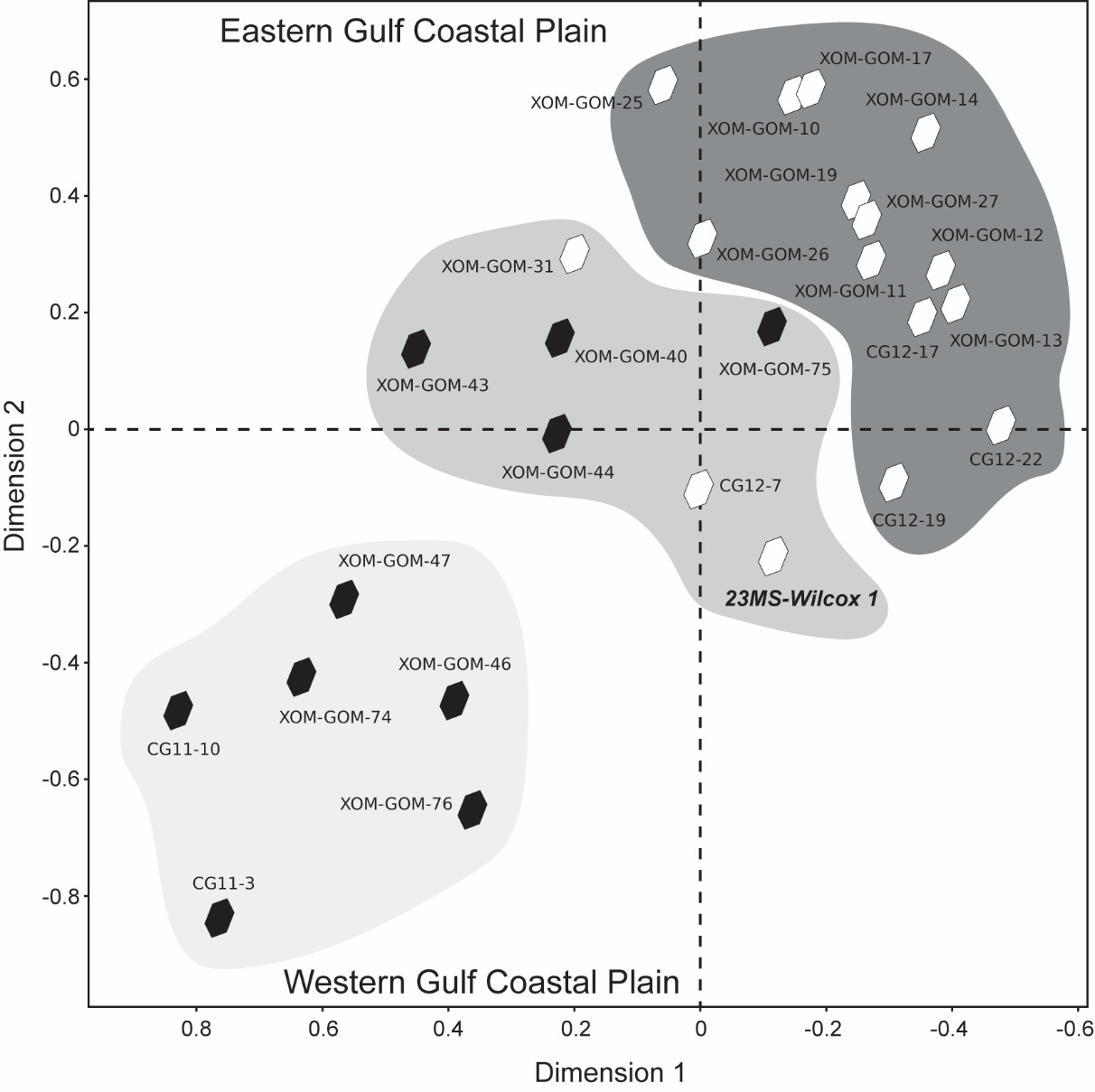
A third interpreted cluster in MDS space is presented between these two age spectra end members. This cluster is representative of a mixture between the two signatures and also shows spatially heterogeneity, with western Gulf Coastal Plain age spectra appearing along the eastern Gulf Coastal Plain and vice versa. For example, samples XOM-GOM-40, 43, 44, and 75 (M. D. Blum et al., 2017) are located along the western Gulf Coastal Plain and northern Mississippi Embayment yet are proportionally dominated by Grenville grains and contain few to no western North America Cordillera grains. Likewise, samples XOM-GOM-31 and CG12-19 are located along the eastern Gulf Coastal Plain yet contain a western North America Cordillera sample signature. Sample 23MS-Wilcox 1 is within this third cluster and exhibits an age spectrum with proportions typical of an eastern Gulf Coastal Plain sample with the addition of western North America Cordillera grains. This pattern supports interpretations of long-distance sediment transport and integrated drainage systems that delivered both volcanic and basement-derived zircons to the Gulf of Mexico during the Paleocene-Eocene, extending beyond local Laramide uplifts (Mackey, 2009; Mackey et al., 2012). These findings reinforce the idea that Wilcox Group provenance reflects complex, basin-wide sediment routing networks rather than discrete, proximal terrains.
Three plausible explanations could account for the heterogeneity in Wilcox strata age spectra along the Coastal Plain: the number of analyses per sample, variable laboratory practices, or natural variability associated with depositional processes. Previously reported samples from (N=31, M. D. Blum et al., 2017; Craddock et al., 2021) contain 90-150 age determinations, whereas 23MS-Wilcox 1 contains 355 ages. The increase in grain analyses did not identify new populations in Wilcox strata age spectra but did increase the number of grains in individual populations, especially the Mesozoic and Cenozoic populations. This pattern is consistent with the observations of Sharman and Malkowski (2020), who noted that young zircon grains are typically rare in non-volcanic settings and require large-n sampling strategies to detect. Overall, our increased number of analyses did not influence or change the current state of understanding for what populations are present or absent in Wilcox Group strata but clarify proportionality of grain populations.
23MS-Wilcox 1 was analyzed in the TRAIL at the University of Arkansas while all other comparison samples were analyzed in the LaserChron Center at the University of Arizona. We also employed a whole grain mounting approach, which allowed for depth profiling during analyses. Every other sample was mounted in epoxy and the exterior parts (10s of microns) were removed to expose an internal, cross-sectional area of the grains. Jackson et al. (2021) note the same discrepancies in sample comparison for Cretaceous samples along the eastern Gulf Coastal Plain and show that data are consistent across labs and mounting approaches. The similarity between 23MS-Wilcox 1 to other Wilcox Group samples across the western and eastern Gulf Coastal Plain supports an interpretation that laser ablation inductively coupled plasma mass spectrometry (LA-ICPMS) results produced from various labs using differing analytical approaches can reliably produce comparable datasets.
Paleo-reconstructions for the Late Paleocene and Eocene show regional drainage systems supplying material to the Coastal Plain from the southern Appalachians (eastern Gulf Coastal Plain), Illinois Basin (northern Mississippi Embayment), and Ouachitas (western Gulf Coastal Plain), in addition to a continental-scale drainage bringing material from the western North America Cordillera; this combination of multiple geographic source areas is capable of explaining the heterogeneity in age spectra for Wilcox strata (M. D. Blum et al., 2017; M. Blum & Pecha, 2014; Pecha et al., 2022).
Maximum Depositional Ages
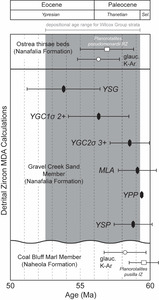
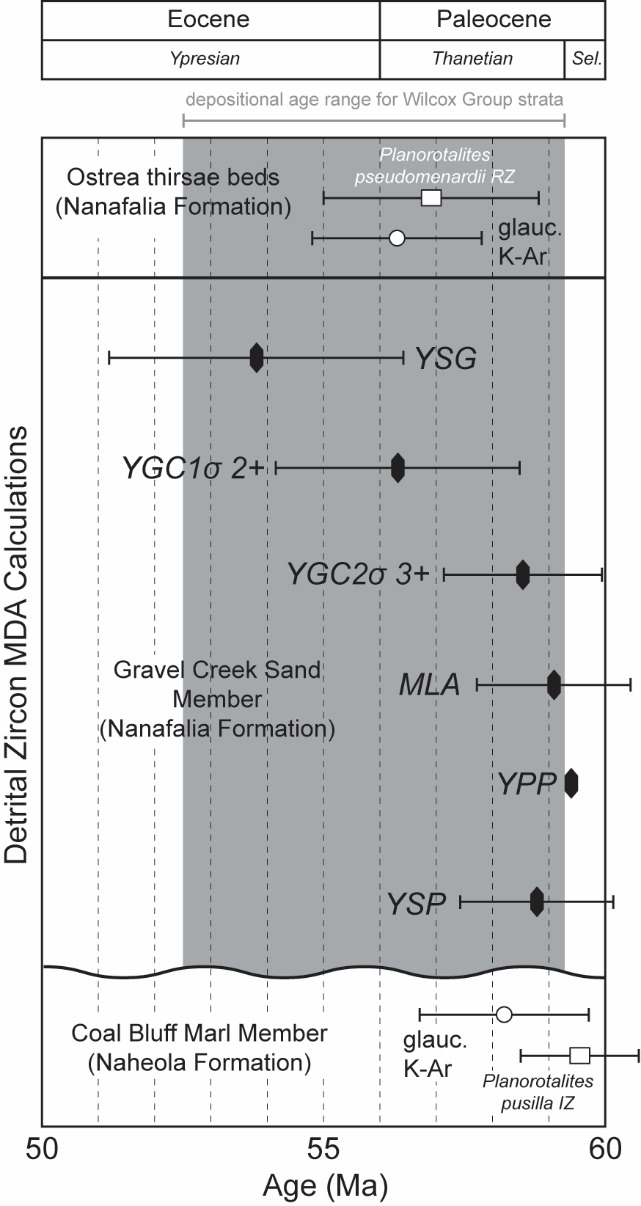
We calculated a MDA for 23MS-Wilcox 1 using six different methods: the youngest single grain (YSG) at a 2σ error level, a weighted mean average (WMA) of the two youngest grain clusters (YGC1σ 2+ and YGC2σ 3+), a maximum likelihood age (MLA), a youngest probability peak (YPP), and a youngest statistical population (YSP) (Table 1; Figure 6). The two WMAs were calculated with cluster of 5 grains (YGC1σ 2+) and 12 grains (YGC2σ 3+). The youngest single grain (YSG) yields an Eocene age of 53.8 ± 2.6 Ma. Weighted mean averages of the youngest grain clusters yield Paleocene ages of 56.3 ± 1.1 Ma MSWD = 0.52 (YGC1σ 2+) and 58.5 ± 0.7 Ma MSWD = 0.89 (YGC2σ 3+), respectively. A maximum likelihood age (MLA) determination yields a Paleocene age of 59.1 ± 1.4 Ma at a 2σ uncertainty. The youngest probability peak 9YPP) yields an age of 58.8 Ma, while the youngest statistical population (YSP) yields an age of 58.8 ± 0.7 Ma.
DISCUSSION
Sediment Provenance
Blum and Pecha (2014) and Blum et al. (2017) demonstrate a major drainage reorganization in the Gulf Coastal Plain between the Late Cretaceous (Tuscaloosa Group) and Paleocene-Eocene (Wilcox Group) based on age spectra defining regionally-sourced material from the southern Appalachians versus a mixture recycled Paleozoic and/or Mesozoic strata with western North American Cordillera ages. Craddock and Kylander (2013) further support the persistence of these drainage patterns throughout the Cenozoic, demonstrating consistent sediment contributions from Sevier-Laramide and Appalachian sources in the Mississippi River Delta. Similarly, Xu et al. (2017) show that continental-scale drainage systems remained active into the Miocene, delivering sediment from both western and eastern source terranes into the Gulf of Mexico Basin. The presence of western North America Cordillera grains requires a continental-scale routing system, given the absence of appropriate Mesozoic and Cenozoic source rocks in eastern and southeastern North America. Upper Cretaceous detrital zircon studies on the Ripley-McNairy Sand interval along the northern Mississippi Embayment and eastern Gulf Coastal Plain indicate dominantly Appalachian sources, further bracketing the drainage reorganization to at least the Maastrichtian (Gifford et al., 2020; Jackson et al., 2021; Potter-McIntyre et al., 2018).
The detrital zircon U-Pb geochronology of the basal Wilcox Group presented here provides insights to the evolution of continental-scale drainage systems during the Paleocene-Eocene transition in the eastern Gulf Coastal Plain. Our data suggest a shift from the predominantly Appalachian-sourced, Late Cretaceous drainage networks to a complex, transcontinental system that incorporated sediment sources from the western North American Cordillera mixed with Paleozoic strata from either the Illinois Basin or Appalachian foreland, and or locally recycled Cretaceous strata from the Mississippi Embayment. The presence of both Mesozoic and Cenozoic detrital zircon populations in 23MS-Wilcox1 necessitates long-distance sediment transport mechanisms that operated across the North American continent. This provenance signature cannot be explained by local recycling of underlying Cretaceous strata alone but rather requires a routing system capable of delivering western Cordilleran volcanic material to depositional sites because no source rocks containing these age ranges are identified in eastern North America.
The sequence stratigraphic context of the Gravel Creek Sand interval provides important constraints on the mechanisms driving provenance reorganization. The basal contact of the Wilcox Group in northeastern Mississippi is interpreted to reflect lowstand incision during base-level fall. The Gravel Creek Sand Member (and correlative strata) represents fluvial infill of this paleovalley, deposited disconformably over the highstand systems tract of the Naheola Formation (Coal Bluff Marl Member), which records maximum transgression and progradation prior to basal Wilcox deposition. This interpretation is consistent with the sequence stratigraphic model of Mancini and Tew (1995). Under these lowstand conditions, the newly established transcontinental drainage system was capable of efficiently transporting near syndepositional volcanic zircons from active Cordilleran sources (e.g., Pecha et al., 2022). Transport of volcanic sources downstream into the Wilcox systems along the paleo-Gulf Coastal Plain would have operated on timescales unresolvable (less than) the associated error for individual detrital zircon ages, which allows for the assumption that the lag time between zircon generation to zircon deposition be considered instantaneous. This assumption has been noted since the early advent of sediment provenance studies utilizing detrital zircon geochronology, which showed that the size of the drainage network was positively correlated to the deposit containing near syn-depositional zircons (e.g., Anderson, 2001).
Sandy valley fills, like the Gravel Creek Sand Member and correlative strata, are typically deposited under high-energy conditions that are generally poor for the preservation of delicate fossils and complete assemblages, limiting their biostratigraphic utility. The absence of marine markers provide little constraint on the stratigraphic and chronological relationship of these strata to those down-dip along the Paleocene Gulf Coast. Although paleofloral analysis may provide more age resolution, current understanding of the pollen systematics in the Mississippi embayment do not provide detailed stage information (Frederiksen et al., 1982; Oboh-Ikuenobe et al., 2012).
While the continental-scale drainage framework is well-established, reconstructing sediment provenance from detrital zircon age spectra at a regional-scale across the Gulf Coastal Plain proves more difficult because of the natural variability in age spectra and similar signatures in potential source rocks. Wilcox samples along the western Gulf Coastal Plain typically have a larger abundance of Mesozoic and Cenozoic grains alongside a noticeable increase in Paleoproterozoic (Yavapai-Mazatzal) grains. Samples from the eastern Gulf Coastal Plain typically contain few to no Mesozoic and Cenozoic grains and are characterized by a large Mesoproterozoic (Grenville) population alongside smaller Paleozoic (Appalachian), Neoproterozoic (peri-Gondwana), Mesoproterozoic (Granite-Rhyolite) populations that are proportionately similar to Mississippian through Permian strata in the Appalachian foreland (e.g., Thomas, 2011; Thomas et al., 2017). However, this Paleozoic detrital zircon signature exists in Mississippian-Pennsylvanian strata in the Ouachita foreland and the Illinois, Forest City, Michigan, and Fort Worth basins as well (Thomas et al., 2020; 2021; Jackson et al., 2026; McKay & Jackson, 2024). Given this regional variability, facies relationships require that material be routed more from the north than from the west (Mancini & Tew, 1995). This directional constraint suggests that recycled Paleozoic strata from the Illinois Basin are the likely sediment source rock, with limited input from the Appalachian foreland to the east. Three potential routing and mixing scenarios emerge that satisfy both the age spectrum and the northward transport direction.
The first scenario involves routing material through the northern Mississippi Embayment and Mid-Continent, recycling Pennsylvanian strata from the Illinois Basin and or up Cretaceous strata in the northern Mississippi Embayment providing the needed source signature of pre-Mesozoic grains in the 23MS-Wilcox 1 age spectrum. This routing pathway would only require the addition of Mesozoic and Cenozoic grains from the western North America Cordillera to complete the observed age spectrum. These scenarios can both be supported by the similarity between 23MS-Wilcox 1 and samples GOM-40 and GOM-43 in the northern part of the Mississippi Embayment.
A second scenario involves routing material from the western Cordillera to the eastern Gulf Coastal Plain via continental-scale drainage network and then mixing with locally derived southern Appalachian foreland Paleozoic strata and or recycled up-dip Cretaceous strata. The location of 23MS-Wilcox 1 is important to consider for this scenario. In paleo-reconstructions, the sample would be located along the southeastern margin of the drainage network that is ultimately associated with the Holy Springs depo center. The sample is also located in an ambiguous “mixing zone” for Cretaceous deposits, where sediment provenance signatures derived from the Appalachian foreland versus southern Appalachian eastern Blue Ridge and Inner Piedmont are heterogeneously distributed (i.e., Jackson et al., 2021). The age spectra similarity between 23MS-Wilcox 1 and sample GC12-7 along the eastern Gulf Coastal Plain support this interpretation.
A final scenario is envisioned that sources all detrital zircon provenance signatures from source rocks in the western North American cordillera. Wilcox Group deposition coincides temporally with the exhumation of western US Cordillera Front Range blocks, which would be capable of exposing all necessary potential source rocks to result in 23MS-Wilcox 1 age spectrum. The detrital zircon age spectra of down system deposits typically mimic source rocks in the headwater regions, relying on confluences of major tributaries with distinctively different source terranes within their subnetworks to affect the proportions and presence of populations (i.e., Gregory et al., 2022). The 23MS-Wilcox 1 age spectrum shows visual similarity to that identified in western US Jurassic (Morrison Formation) and Cretaceous (Lytle and Dakota formations) strata age spectra (e.g., Allred et al., 2023). This observation could be interpreted to suggest that the entire age spectra in 23MS-Wilcox 1 is derived from western North American cordillera source rocks, with little to no down stream influx of local sediment.
We prefer a source to sink model that emphasizes routing through the northern Mississippi Embayment and Mid-Continent with recycling of either Illinois Basin Pennsylvanian strata or northern Mississippi Embayment Cretaceous strata, supplemented by western North American Cordillera volcanic input. This interpretation is most consistent with the directional constraints imposed by facies relationships (Mancini & Tew, 1995), which require northward rather than westward sediment transport. The pre-Mesozoic age spectrum of 23MS-Wilcox 1 and samples GOM-40 and GOM-43 provides additional support for this routing pathway. While the temporal coincidence of Wilcox deposition with Front Range exhumation is intriguing, it appears more plausible that an existing drainage network evolved to incorporate western Cordilleran material rather than developing entirely new transcontinental pathways from western US headwaters. This model represents a mechanistically feasible explanation for the observed continental-scale drainage reorganization that accommodates both the regional geological constraints, and the complex provenance signature preserved in the basal Wilcox Group.
Limitations exist for this provenance interpretation. Our inability to decipher multiple generations of sediment recycling prohibits determining whether the age spectrum for Paleozoic and older zircons in 23MS-Wilcox 1 were derived from source rocks near the headwater regions throughout the western North American Cordillera, Paleozoic strata from the Illinois Basin, or up-dip Cretaceous and earliest Paleocene strata in the Mississippi Embayment. Previous studies document Triassic and Jurassic units throughout the western North American Cordillera that contain the typical Appalachian foreland signature (e.g., Dickinson & Gehrels, 2009; Alred and Blum, 2023). The increased proportional abundance of Yavapai-Mazatzal grains seems to support a western cordilleran derived provenance; however, McKay et al. (2021) show that proportions of Proterozoic grain populations can be found and influenced by input from Cambrian through Devonian sedimentary rock sources in the southern Appalachian foreland thrust belt. Future studies likely will need to focus on the geochemical and isotopic signatures of Mesozoic grains and zircon helium signatures for Paleozoic and Proterozoic grains in the age spectrum to refine sediment source terranes. Another complication is the incorporation of near syndepostional Cenozoic zircons into the age spectrum. The grains could have been introduced to the drainage network via erosion of bedrock and fluvial transport, gravitational fallout from volcanic eruptions, or aeolian transport. While not a definitive statement, we favor fluvial transport because of the irregular morphology of grains encountered during laser ablation, lack of elongated c-axis to short axis ratios (indicative of an extrusive volcanic genesis), and lack of pitting on zircon surfaces (aeolian transport byproduct).
Maximum Depositional Age
The presence of near syndepositional grains in Wilcox strata, along with sediment provenance and depositional setting context, indicates that detrital zircon U-Pb geochronology is an ideal approach to understand stratigraphic ages for the Gravel Creek Sand Member and correlative strata throughout the eastern Gulf Coastal Plain. However, results from this study highlight the complexity in assessing various MDA approaches and the geologic implications between determinations (Table 1; Figures 6). For example, if the YSG is used for a MDA then the basal Wilcox, and by extension the entire Wilcox Group, should be interpreted as Eocene. This is problematic because an Eocene age for the basal Wilcox is at odds with biostratigraphic determinations for this horizon in Mississippi and Alabama (Elsik & Crabaugh, 2001; Mancini & Tew, 1995; Zarra et al., 2019). The YSG is a good analysis, which passed all quality control filters during data reduction. It also overlaps in 2σ error with the biostratigraphic and a glauconitic sand K-Ar age for the overlying Ostrea thirsae beds. However, it is noticeably younger in age than the underlying Coal Bluff Marl Member and all other MDA calculations.
The use of the youngest single grain (YSG) champions individual grains that would commonly be classified as outliers (i.e., Copeland, 2020). While use of the YSG often provides insight to the MDA of a studied interval, the approach can be problematic from an analytical perspective. Previous studies show that increasing the n-value of detrital zircon samples increases the probability of defining the full spectrum of ages within the studied interval (Ibañez-Mejia et al., 2018; Pullen et al., 2014; Sharman & Malkowski, 2023; Sundell et al., 2024). A logical extension of this observation is that increased n-values would also increase the likelihood of defining the youngest grain population. However, Horstwood et al. (2016) summarize how a 1-2% analytical accuracy limitation and internal instrumental drift can cause LA-ICPMS analysis of zircon standards to deviate greater than 2-sigma error away from the true age of the zircon established by chemical abrasion isotope dilution thermal ionization mass spectrometry (CA-ID-TIMS). Recent studies also show that LA-ICPMS analyses consistently produce younger ages than CA-ID-TIMS determinations (Sharman and Malkowski, 2024; Howard et al., 2024). This implies that large n-value acquisition also likely increases the probability of capturing detrital zircon ages that are not truly associated with a natural process and instead a byproduct of analytical uncertainties.
Using the YSG grain for MDA determination is also problematic from a geologic process standpoint. For a MDA to approach the true depositional age of a deposit, sediment incorporated from an area exhibiting active volcanism (likely from an active margin) is required. In this geologic setting the youngest zircon grains will be derived from a volcanic or exhumed plutonic source and therefore should be treated as such by calculating a weighted mean average. Utilizing the youngest single grain in these settings embraces outliers that may misrepresent geologic processes.
Proponents of a weighted mean average (WMA) of the youngest population invoke a more conservative standpoint, formulated to guard against outliers. When calculating a weighted mean average a debate also arises on how to define the youngest population (n-value of grains) and the justification for exclusion of grains. Most studies tend to exclude an individual analysis if it falls outside of 1- or 2-sigma error with the youngest population. However, on an individual grain-by-grain basis, these justifications (assumptions) are unsubstantiated, especially when the analysis passes all data filtering parameters (Copeland, 2020). The YGC1σ 2+ approach results in a late Paleocene age that overlaps the Paleocene-Eocene boundary and the YSG in uncertainty. The YGC2σ 3+ results in a Paleocene age for the basal Wilcox interval and does not overlap in uncertainty with the YSG. Both of the weight mean averages are shifted towards younger MDAs with respect of MLA, YPP, and YSP results, suggesting that they may not reflect the true depositional age of the unit. This shift towards younger MDA determinations likely represents a response to the increased number of analyses for sample 23MS-Wilcox 1.
Vermeesch (2021) shows that varying YSG and WMA (YGC1σ 2+ and YGC2σ 3+) approaches for calculating MDAs often produce age determinations younger than the true depositional age and that a maximum likelihood age (MLA) determination produces more realistic results. While this approach to assigning MDAs is more objective, it along with other MDA approaches still require incorporation of process and geologic (basin) setting. Schwartz et al. (2023) date Neogene strata in Death Valley, highlighting the ability for MLA determinations to produce robust MDAs in a setting where near syndepositional zircons are present over the studied stratigraphic interval. Other studies utilize the youngest probability peak (YPP) and youngest statistical Population (YSP) alongside the MLA to demonstrate agreement between the approaches; thereby, providing a reliable interpretation based on MDA results (Herriott et al., 2019; Romero et al., 2024).
The MLA determination for 23MS-Wilcox 1 agrees well with YSP and YPP determinations, suggesting the convergence on a robust MDA for the basal Wilcox strata. This MDA also agrees well with biostratigraphic and glauconitic sand K-Ar data in down-dip correlative strata, is consistent with sediment provenance for correlative strata to the Gravel Creek Sand Member, and integrates well with geologic and depositional settings. These results establish a Late Paleocene age for the up-dip fluvial deposits of the basal Wilcox Group along the eastern part of the Mississippi embayment in northern Mississippi. However, the analytical limitations in this age should be noted. While our data were able to produce a reliable, geologically consistent MDA determination, samples with fewer analyses (n≈100) lack the ability to consistently reproduce this result (Table 1). The error associated with individual LA-ICPMS analyses is also quite large (1-2%), resulting in ambiguous 2σ overlaps for age determinations associated with various MDA approaches. Recent studies aimed at establishing chronostratigraphic context demonstrate the need for higher precision ages by CA-ID-TIMS analysis to confidently assess individual zircon ages (e.g., Sharman et al., 2023). While CA-ID-TIMS remains cost prohibitive and more labor intensive than LA-ICPMS, future studies should rely on these data to advance MDA determinations.
Broader Implications
The MLA for sample 23MS-Wilcox 1 (59.1 ± 1.36 Ma) places correlative strata to the Gravel Creek Sand Member mapped by Thompson (2000) in northern Mississippi within the upper Selandian to lower Thanetian age, consistent with the basal TAGC-2.2 sequence of Mancini and Tew (1995). Time-correlative onshore strata along the Texas Gulf Coast indicate a regional flooding surface during this interval (Sharma et al., 2025), which is consistent with up-dip fluvial aggradation in the Mississippi embayment during transgression along the Paleocene Gulf Coast as opposed to the traditional interpretation of the Gravel Creek Sand Member as a incised valley-fill deposit associated with a lowstand systems tract (Mancini & Tew, 1995). This time is also correlated to a transient climate perturbation termed the Selandian-Thanetian Transition Event (STTE) associated with warming (Coccioni et al., 2019) and enhanced chemical weathering (Sharma et al., 2025). Eustatic sea-level variations during the Paleocene were moderate and of low amplitude (Miller et al., 2020), thus regional transgression and regression along coastal settings was likely driven by strong signals from climate and sediment supply (Zhang et al., 2016). Increased topographic gradients created by Laramide tectonics in the hinterland along with high sediment load (Galloway, 2008) associated enhanced chemical weathering during the STTE may be key drivers for up-dip aggradation during Paleocene sequence deposition along the Mississippi Gulf Coast. These results, when considered alongside detrital zircon data from younger Cenozoic and Miocene deposits (Craddock & Kylander-Clark, 2013; Xu et al., 2017), suggest that the integration of western and eastern source terranes into a single, continent-scale sediment routing system persisted well beyond the Paleocene, highlighting the long-term stability and geologic significance of these drainage networks in shaping Gulf Coastal Plain stratigraphy.
CONCLUSIONS
Sample 23MS-Wilcox 1, collected along the eastern Gulf Coastal Plain from basal Wilcox Group strata in northeastern Mississippi, contains detrital zircon U-Pb ages associated with the western North American Cordillera (< 250 Ma), Appalachian (490-270 Ma), Peri Gondwana (850-550 Ma), Grenville (1250-900 Ma), Granite-Rhyolite (1550-1300 Ma), Yavapai-Mazatzal (1800-1600 Ma), and Wyoming (2700-2400 Ma) populations. This age spectrum reflects a continental-scale drainage derived from a mixture of western North America Cordillera and regionally sourced material from either recycled Paleozoic strata in the Illinois Basin or Appalachian foreland, and or up dip Cretaceous strata from the northern Mississippi Embayment. A comparison to other Wilcox Group samples shows that the presence of western North American Cordillera grains (Mesozoic and Cenozoic ages) and the abundance of Grenville grains are the primary controls on age spectra dissimilarity across the western and eastern Gulf Coastal Plain outcrop belts.
Integration of the depositional environment and geologic setting (continental-scale drainage and deposition in an up-dip fluvial system during transgression) supports the interpretation that the youngest zircon grains closely approach the true depositional age of studied interval. A population of Cenozoic grains (n=18) from 23MS-Wilcox 1 yield MDA determinations from the latest Paleocene (YGC1σ 2+, YGC2σ 3+, MLA, YPP, YSP) to earliest Eocene (YSG). These results document how the increased number of analyses per sample can shift YSG, YGC1 2+, and YGC2 3+ MDAs towards younger ages that deviate away from the true depositional age of the stratigraphic interval; highlighting the difficulty in determining an MDA based on LA-ICPMS data alone. Coupling MDAs with existing biostratigraphic and glauconitic sand K-Ar data suggests that the MLA determination of 59.1 ± 1.4 Ma is the most objective approach to establishing a MDA for basal Wilcox Group strata along the eastern Gulf Coastal Plain. The MLA determination for sample 23MS-Wilcox 1 is corroborated by YSP and YPP determinations and fits well with recent concepts of increased sediment supply during climate- and eustatic-driven transgression along the Paleocene North American Gulf Coast.
Acknowledgments
This work is an outgrowth of Coastal Plain work supported through USGS cooperative agreements G18AC00142, G22AC00182, and G23AC00179 (Jackson) within the EDMAP initiative. The findings and conclusions in this article are those of the authors and do not necessarily represent the views of the U.S. Geological Survey. Foster and Holland Jackson are thanked for field assistance. Zirchron, LLC is acknowledged for heavy mineral separation. Devon Orme and two anonymous reviewers provided comments that greatly improved the original manuscript. Lizzy Trower is thanked for editorial handling the submission.